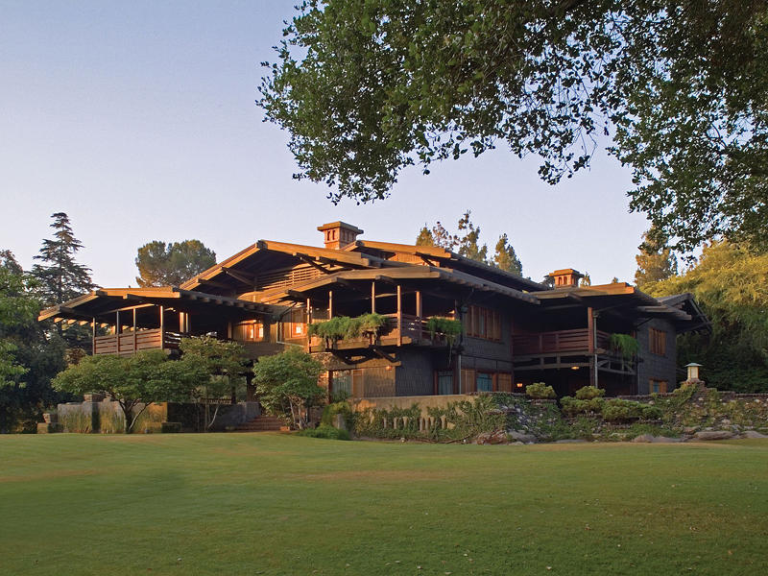
Gamble House

© Alex Vertikoff
ARCHITECT :
Greene & Greene
LOCATION :
Pasadena, California
REGION :
West
YEAR :
1908-1909
STYLE :
American Arts & Crafts
SECONDARY :
California Bungalow
STATUS :
Preserved Museum

NOTES
The Gamble House was designated a National Historic Landmark in 1977 and is currently stewarded by the Univerity of Southern Californi and the City of Pasadena.

Originally commissioned as a defining work of arts and crafts architecture, the Gamble House reflects the architectural vision of Greene & Greene. Completed in 1909, the project emphasizes proportion, clarity, and disciplined composition. The Gamble House presents a study in restraint and refinement within the American Arts & Crafts movement. Its steeply pitched rooflines depart from the low horizontals of Prairie architecture, instead embracing vertical rhythm and a sculptural silhouette.

Here, the gable is not decorative. It is the organizing principle of the house, shaping massing, directing light, and revealing the logic of construction with quiet confidence.

Carefully ordered structure, restrained materials, and deliberate spatial planning shape the building’s character and reinforce its architectural intent.

Craft, material, and structure working in quiet harmony.

The pronounced gables turn construction into ornament through proportion, joinery, and shadow.

Spatial Experience:

Within the Gamble House, space unfolds as a sequence rather than a single gesture. Rooms are layered and interconnected, defined by low thresholds, deep overhangs, and built-in elements that guide movement without interruption. The transition from compression to openness is subtle but intentional, with ceilings lifting beneath exposed beams and light filtering through art glass and shaded apertures. This creates an atmosphere that feels both intimate and expansive, where structure, material, and proportion quietly shape the experience of inhabiting the home.

Material + Detail:

Material selection plays a central role. Warm-toned woods are allowed to age and deepen over time, reinforcing the connection between the house and its environment. Unlike more formal architectural traditions, there is no attempt to conceal construction. Instead, the structure is revealed, celebrated, and refined.

Today the Gamble House remains an important reference point within the study of arts and crafts architecture and continues to influence architectural scholarship and preservation.

  • Greene & Greene are known for turning structural joinery into ornament, rather than applying decoration.
  • The expressive gable contrasts with Prairie School horizontality, offering a more vertical architectural rhythm.
  • Exposed rafters and beam ends are both functional and aesthetic, a defining feature of California Craftsman design.
  • The house reflects a strong connection to Japanese woodworking influence, visible in proportion and detailing.

Widely regarded as the most complete expression of the American Arts & Crafts ideal, the Gamble House is less a residence than a total work of art, where architecture, interior, and object exist in perfect continuity.