Charnley-Persky House

Architect:

Louis Sullivan
Frank Lloyd Wright

Location:

Chicago, Illinois

Region:

West

Year(s):

1892

Style:

Early Prairie School Architecture

Secondary:

Proto-Modern Residential Architecture

Status:

Museum and Achitectural Archive
National Historic Landmark

NOTES
The Charnley-Persky House was designated a National Historic Landmark in 1970, as well as designated a Chicago Landmark in 1991. The property is stewarded by the Society of Architectural Historians

On a quiet Gold Coast street in Chicago, the Charnley-Persky House announced a new architectural language. Designed by Louis Sullivan with major contribution from Frank Lloyd Wright, the residence stripped away Victorian excess in favor of geometry, proportion, and disciplined calm. It remains one of America’s earliest modern houses.

Ornament serves architecture rather than competing with it.

Widely recognized as a turning point in American domestic architecture. At a moment when Victorian houses favored decorative abundance, this residence embraced restraint.

Its façade uses symmetry, clean wall planes, strong horizontal emphasis, and carefully limited ornament. The result feels unexpectedly modern, anticipating design movements that would not fully emerge for decades.

The project also marks an important bridge between Sullivan’s philosophy of organic form and Wright’s future Prairie experiments.

Spatial Experience:

From the street, the house appears composed and self-assured. Its quiet exterior conceals an interior organized around light, volume, and movement rather than superficial display.

Inside, circulation feels intentional and progressive. Rooms relate through proportion and spatial hierarchy. The house rewards close attention, revealing sophistication through sequence rather than spectacle.

Material + Detail:

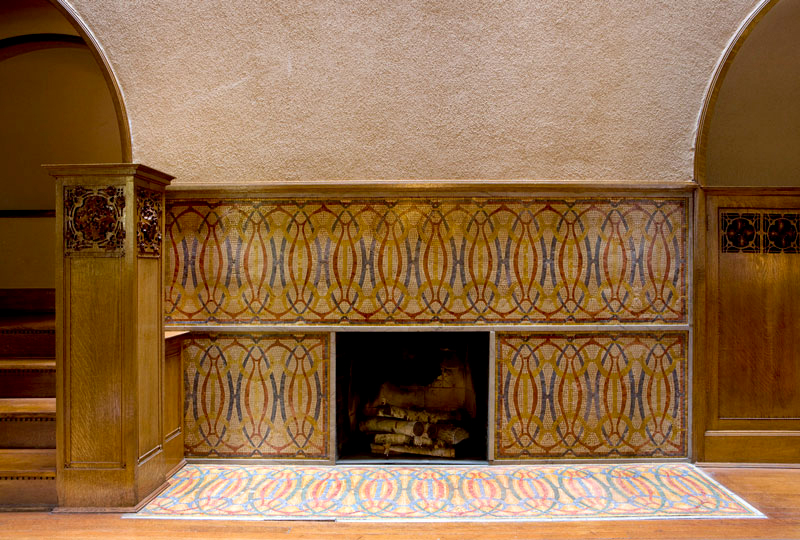
This design relies on disciplined materials and selective emphasis. Brick, wood, plaster, and carefully framed openings create warmth without visual clutter.

Detail is concentrated where it matters most: window composition, carved elements, railings, and transitions between surfaces. Ornament serves architecture rather than competing with it.


  • Considered among the earliest modern American houses
  • Crucial collaboration point between Sullivan and Wright
  • Exterior restraint contrasted with rich interior refinement
  • Gold Coast location places it in elite historic Chicago context
  • Demonstrates that minimalism can still feel luxurious

The Charnley-Persky House feels contemporary because its values remain current: clarity, proportion, material honesty, and controlled richness. In an era of overstimulation, the house shows how understatement can carry authority.