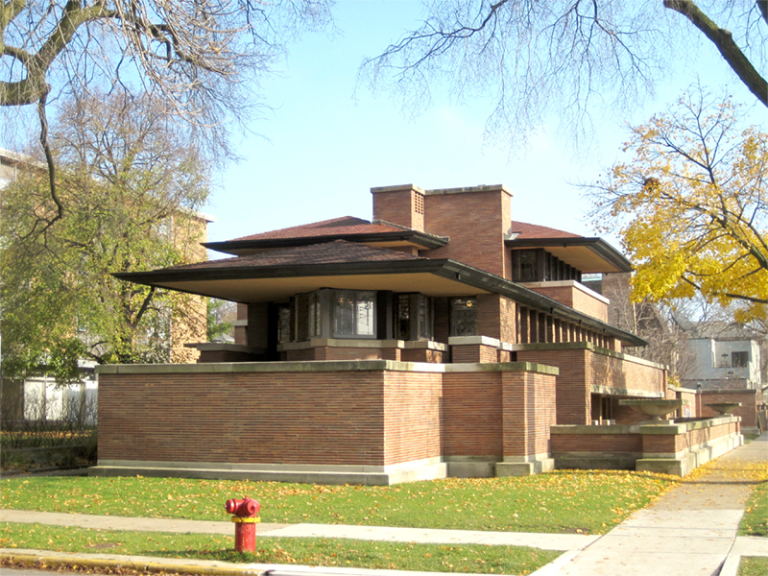
Frederick C. Robie House

Teemu08, CC BY-SA 3.0 via Wikimedia Commons
ARCHITECT :
Frank Lloyd Wright
LOCATION :
Chicago, Illinois
REGION :
Midwest
YEAR :
1910
STYLE :
Prairie School
SECONDARY :
Organic Architecture
STATUS :
Extant (Restored)

NOTES
Part of UNESCO’s The 20th-Century Architecture of Frank Lloyd Wright, Robie House is a landmark of the Prairie School. Wright designed 175 doors and windows for the house; 163 original casements remain. A comprehensive restoration completed in 2019 renewed major elements while preserving its architectural character.

Commissioned by Frederick C. Robie, the house is a defining achievement of Wright’s Prairie School. Its broad roof planes, twenty-foot cantilever, and continuous bands of leaded glass give its horizontal lines a powerful presence on the Chicago street.

Rather than treating rooms as enclosed boxes, Wright composes a sequence of sheltered and expanding spaces. Built-in furnishings, layered ceiling planes, and long sightlines make the interior feel both intimate and expansive.

At Robie House, structure, ornament, and daily life are inseparable. That idea would influence the course of modern domestic architecture.

“Long horizontal rooflines dissolve the boundary between interior and landscape.”

Spatial Experience:
Approach is deliberate. The house stretches low across its site, revealing itself in stages before compressing at the entry. Inside, space expands horizontally, with continuous sightlines extending outward through bands of art glass that filter light into shifting geometric patterns.

Material + Detail:
Roman brick, wood, and leaded glass establish a disciplined palette. Ornament is embedded, not applied, expressed through proportion, repetition, and the integration of structure and detail. Every surface participates in the composition.

Completed in 1910, the house represents the culmination of Wright’s Prairie period. It stands not as an experiment, but as a resolution, where structure, ornament, and space are fully unified.


The Robie House is often considered one of Frank Lloyd Wright’s most complete architectural statements.